15 Seville Hotels and the Patios They Were Built Around
An Exposition palace still in the city’s hands, a sixteenth-century coaching inn, the house of a flamenco guitarist, and fourteen houses joined into one hotel facing the Giralda.
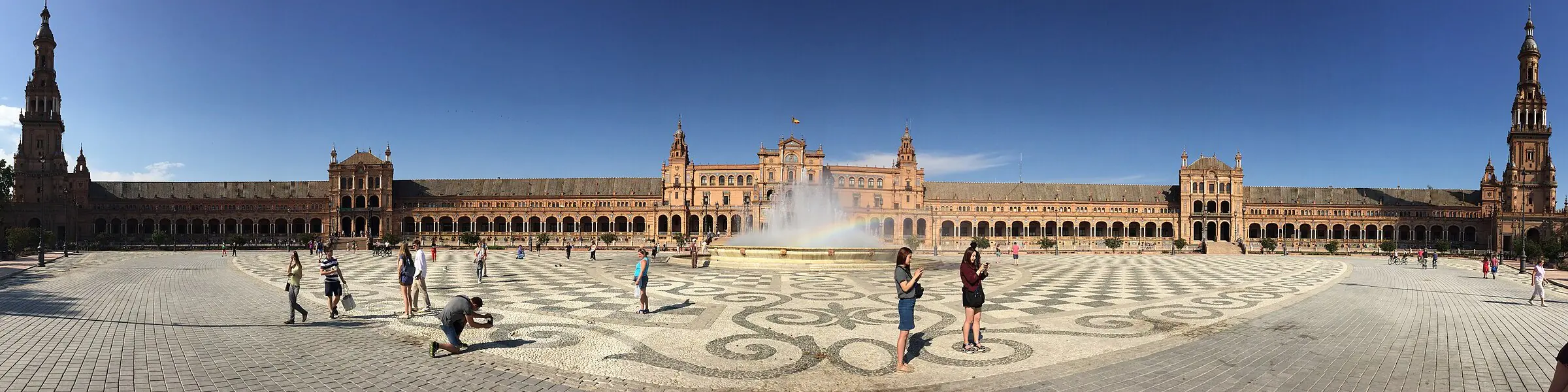
Seville builds its hotels around patios, and the patios came first. This list has the Alfonso XIII, raised by the city for the 1929 Ibero-American Exposition and still owned by it, a sixteenth-century coaching inn on Calle Almirante Apodaca, the house where the flamenco guitarist Niño Ricardo lived, and Las Casas de la Judería, 27 houses of the old Jewish quarter joined by alleys and an underground passage.
The list is grouped by character, not ranked. Where a hotel’s own site could be confirmed, its name links there; the rest are listed without one.
Grand hotels of the Exposition era
Hotel Alfonso XIII, a Luxury Collection Hotel, Seville · Santa Cruz (Puerta de Jerez)
The Alfonso XIII was commissioned by the city to lodge dignitaries at the 1929 Ibero-American Exposition and inaugurated in April 1928 by King Alfonso XIII and Queen Victoria Eugenia. José Espiau y Muñoz designed it in the neo-Mudéjar regionalist style around a central arcaded patio. The building is still owned by Seville’s city council, which leases it to Marriott’s Luxury Collection.
Colón Gran Meliá · El Arenal
The Colón opened in 1929 to house visitors to the Ibero-American Exposition. Its lobby keeps the original stained-glass cupola, restored when Meliá reopened the hotel in 2009. It is often called the matadors’ hotel, where bullfighters dress before walking to the Maestranza.
Hotel Inglaterra · Centro (Plaza Nueva)
The Inglaterra opened in 1857 on Plaza Nueva, facing the city hall. It bills itself as the oldest hotel in Seville, run by the same family across generations.
Palaces, a corral de vecinos and a sixteenth-century inn
CoolRooms Palacio de Villapanés · San Bartolomé
The Palacio de Villapanés is an eighteenth-century palace built for the Marquises of Villapanés on Calle Santiago. It opened as a hotel in 2010 after a restoration that kept the marble staircase and central patio, and now runs under the CoolRooms name.
Hotel Boutique Palacio Pinello · Santa Cruz
The Palacio Pinello is a sixteenth-century palace the hotel links to the Pinelo family, Genoese bankers who backed Columbus’s voyages. It was restored around a two-storey columned patio and is run by Barcelona’s Majestic Hotel Group.
Mercer Sevilla · El Arenal
The Mercer Sevilla is set in the nineteenth-century Casa Palacio Castelar on Calle Castelar in El Arenal. The Seville architects Cruz y Ortiz converted it, and it opened in 2016.
Hotel Posada del Lucero · Centro (Santa Catalina)
The Posada del Lucero is a sixteenth-century coaching inn on Calle Almirante Apodaca, said to be the last of Seville’s historic posadas still standing, and a listed monument. The Seville architect Adolfo Pérez converted it into a hotel, keeping the original two-storey galleried courtyard.
Hospes Las Casas del Rey de Baeza · Centro (Santa Catalina)
Las Casas del Rey de Baeza is an eighteenth-century corral de vecinos, the communal housing of old Seville arranged around shared cobbled courtyards with wooden galleries. The rooftop pool looks over Santa Catalina toward the Giralda.
Houses with a name attached
La Casa del Maestro · Centro (Alfalfa)
La Casa del Maestro occupies, by the hotel’s account, the house where the flamenco guitarist Niño Ricardo lived, on a street since renamed for him. Niño Ricardo, born Manuel Serrapí Sánchez, was Seville’s leading flamenco guitarist of his generation and a direct influence on Paco de Lucía.
Hotel Palacio Alcázar · Santa Cruz (Plaza de la Alianza)
The Palacio Alcázar occupies what the hotel describes as the former studio and home of John Fulton, the Philadelphia-born painter who became the first American to take the alternativa as a full matador in Spain. Its rooftop bar, Fulton Terraza, is named for him and faces the Alcázar walls and the Giralda.
Taberna del Alabardero · El Arenal
The Taberna del Alabardero is a nineteenth-century mansion in El Arenal, said to have been the home of the poet and playwright Juan Antonio Cavestany. The priest and restaurateur Luis de Lezama, whose original Taberna del Alabardero opened in Madrid in 1974, runs it with a handful of guest rooms above the dining rooms. It houses the Escuela Superior de Hostelería de Sevilla, so trainees staff the kitchens and dining rooms.
Hotel Amadeus & La Música · Santa Cruz
The Amadeus occupies an eighteenth-century house on Calle Farnesio in Santa Cruz. It is run by a family of musicians and, by the hotel’s account, has pianos in some rooms and soundproofed practice rooms open to guests. Rooms carry composers’ names and the roof terrace faces the Giralda.
In the shadow of the Cathedral
Las Casas de la Judería · Santa Cruz
Las Casas de la Judería joins, by its own count, 27 houses of the old Jewish quarter through alleys, more than forty patios and an underground passage. Ignacio Medina, Duke of Segorbe, assembled it over decades, and it won the 2013 Rafael Manzano Prize for New Traditional Architecture.
EME Catedral Mercer · Santa Cruz (Calle Alemanes)
The EME Catedral is formed, by the hotel’s account, from fourteen adjoining sixteenth-century houses on Calle Alemanes, directly facing the Giralda. It opened in 2008 as the EME Fusion Hotel; Mercer Hoteles took it over in 2021.
Los Seises Sevilla, a Tribute Portfolio Hotel · Santa Cruz (Calle Segovias)
Los Seises occupies part of the sixteenth-century Archbishop’s Palace complex beside the cathedral and traded as the Fontecruz Sevilla Seises before joining Tribute Portfolio. It is named for the seises, the choirboys who dance before the cathedral altar at Corpus Christi and the Immaculate Conception. Roman remains found during the conversion, including a mosaic, are said to be displayed inside.
Frequently Asked Questions
Are these hotels ranked?
No. The groups sort them by character, and the order within each group carries no meaning.
What made a hotel interesting enough for this list?
A story. Every entry was an Exposition-era palace, a coaching inn or corral de vecinos restored, a house tied to a named person, or a set of old houses joined under the cathedral. Comfort alone did not qualify.
Why are there no prices?
Rates change daily and a priced list goes stale in a month. Where a hotel runs its own site, its name links there, so you see the current rate and book direct.
When do these hotels fill up?
Semana Santa and the Feria de Abril, which fall within a few weeks of each other each spring, book out the small Santa Cruz hotels many months ahead and lift rates across the city. July and August run hot and quiet.
Which hotel puts me closest to the day trips on this site?
Most day trips from Seville run to Córdoba, Cádiz, Jerez, Ronda and the white villages, or out to the Roman ruins at Itálica. The Santa Cruz and Arenal hotels sit closest to the coach departures and to Santa Justa station for the fast trains.